

Knee pain is one of the most common reasons people visit their GP in the UK. It affects people of all ages — from teenagers playing sport to women in their 50s noticing their knees getting worse after the menopause. Most of the time, knee pain can be managed well with the right treatment. The problem is knowing where to start.
This guide covers everything you need to know about knee pain treatment in plain English: what causes it, what your options are at every stage, when to see a specialist, and what newer treatments like the Arthrosamid injection offer for people with osteoarthritis who are not ready for surgery.
What Is Knee Pain? And Why Is It So Common?
Your knee is the largest joint in your body. It connects your thigh bone (femur) to your shin bone (tibia), supported by cartilage, ligaments, tendons, and a fluid-filled lining called the synovium. Every time you walk, climb stairs, or rise from a chair, your knee absorbs a significant amount of your body weight.
That is why it is vulnerable. And why, over time, it can start to cause problems.
Knee pain affects approximately one in four adults in the UK at any given time. It becomes significantly more common with age — but age is only part of the story. Your anatomy, your activity levels, your weight, and your hormones all play a role.
Common Causes of Knee Pain
There is no single cause. Knee pain can come from different structures within or around the joint, and the cause determines the right treatment. Here are the most common ones.
Osteoarthritis
This is the most common cause of knee pain in people over 50. Osteoarthritis happens when the cartilage inside the knee gradually wears down. Without that protective cushioning, bone can rub against bone, causing pain, stiffness, and swelling. It tends to develop slowly over years.
Symptoms include morning stiffness that loosens after a few minutes, a creaking or grinding sensation when bending the knee, and pain that gets worse with activity.
Knee Injuries
Sprains, ligament tears, meniscal tears, and fractures are common in people who play sport or have had a fall. These can cause sudden, sharp pain — often alongside swelling, instability, or difficulty bearing weight.
Patellofemoral Pain Syndrome
Often called runner’s knee, this causes pain around or behind the kneecap. It is more common in younger people and those who run, cycle, or go up and down stairs frequently.
Bursitis
The bursae are small fluid-filled sacs that cushion the knee. When they become inflamed — through overuse, kneeling for long periods, or infection — the result is pain and swelling around the joint. This is common in people who spend a lot of time kneeling at work.
Tendonitis
Inflammation of the patellar tendon (the tendon connecting the kneecap to the shin bone) causes pain just below the kneecap, particularly in people who jump or run regularly.
Iliotibial Band Syndrome
The IT band runs along the outside of the thigh and can become tight and inflamed where it crosses the knee. This causes pain on the outer side of the knee, often in runners and cyclists.
Rheumatoid Arthritis and Other Inflammatory Conditions
Unlike osteoarthritis, which is a wear-and-tear condition, rheumatoid arthritis is an autoimmune disease. The immune system attacks the joint lining, causing significant inflammation, swelling, and pain — often affecting both knees and other joints simultaneously. It affects women three times more often than men.
Gout
Gout causes sudden, severe attacks of pain caused by uric acid crystals forming in the joint. Although it more commonly affects the big toe, it can affect the knee. Episodes often come on overnight and are intensely painful.
Knee Pain in Ladies — Why Women Are More Affected
Knee pain in ladies is significantly more common than in men — and it tends to be more severe. This is not coincidence. There are clear biological and structural reasons behind it.
Hormonal Changes at the Menopause
Oestrogen plays a protective role in joint health. It helps reduce inflammation and supports the cartilage that cushions the knee joint. When oestrogen levels fall significantly at the menopause — typically in a woman’s late 40s or 50s — the cartilage loses some of that protection. Many women notice their knee pain begins or worsens noticeably in their 50s. This is one of the main reasons knee osteoarthritis develops and accelerates in post-menopausal women.
The Q-Angle
Women have a wider pelvis than men. This creates a greater angle between the hip and the knee — called the Q-angle. A wider Q-angle places more stress on the inner part of the knee with every step. Over years and decades, this increases cartilage wear, particularly on the inside of the joint.
Muscle Strength
The quadriceps muscles at the front of the thigh are the primary protectors of the knee joint. On average, women have less quadriceps strength relative to body weight than men. Less muscle support means the knee joint absorbs more load during everyday movement.
Ligament Laxity
Women tend to have more flexible ligaments. While useful in some contexts, greater laxity around the knee reduces joint stability and may increase the rate of cartilage damage over time.
The result: Women are significantly more likely to develop knee osteoarthritis than men, tend to develop it earlier, and typically experience more severe symptoms. If you are a woman in your 50s or 60s and your knees are becoming a problem, that is not unusual — and it is not something you simply have to put up with.
My Knee Hurts When I Bend It and Straighten It — What Does That Mean?
This is one of the most common things people describe. Pain or stiffness when bending and straightening the knee — especially first thing in the morning, or after sitting for a while — is a classic sign of knee osteoarthritis.
Other signs include:
- A creaking or grinding sensation when moving the knee
- Swelling around the joint that comes and goes
- Stiffness after rest that eases after a few minutes of movement
- Pain that gets worse with activity and better with rest
- Difficulty on stairs, getting in and out of a car, or rising from a low chair
These symptoms alone do not confirm osteoarthritis. A proper clinical assessment — including examination and imaging — is needed before any diagnosis is made.
Knee Pain Treatment — From Self-Care to Surgery
Knee pain treatment follows a logical progression. You start with the simplest options and move to more advanced treatments if those are not enough. Here is how that ladder looks in practice.
Step 1 — Self-Management at Home
For mild to moderate knee pain, particularly after a minor injury or a flare-up, home management is often the right starting point.
RICE method — Rest, Ice, Compression, Elevation. This remains the standard first response for an acute knee injury. Apply an ice pack wrapped in a cloth for up to 20 minutes, two to three times a day. Avoid ice directly on the skin.
Paracetamol is the first-line painkiller recommended by NICE for knee pain. It is effective, well-tolerated, and has fewer side effects than anti-inflammatories — particularly for older adults.
Topical NSAIDs such as diclofenac gel applied directly to the knee are often recommended before moving to oral anti-inflammatory tablets. They reduce inflammation locally with less systemic risk.
Oral ibuprofen or naproxen can help with more significant inflammation but should be used cautiously in older patients, and those with stomach, kidney, or cardiovascular conditions. Always follow the recommended dose and duration.
Gentle exercise — swimming, cycling, and walking on flat ground — keeps the joint mobile and supports the muscles around the knee without putting excessive impact through it. Complete rest for extended periods tends to make things worse, not better.
Weight management has a significant impact. Each kilogram of body weight creates roughly three to four kilograms of force on the knee joint with each step. Even modest weight loss can produce a meaningful reduction in pain.
Step 2 — Physiotherapy
Physiotherapy is one of the most evidence-based treatments for knee pain at every stage. A physiotherapist will assess your movement, your muscle strength, and the way you load the joint — and design a programme to address the underlying weaknesses.
For knee osteoarthritis specifically, consistent physiotherapy can delay the need for more invasive treatment. The NHS offers physiotherapy and some areas allow you to self-refer without going through your GP first.
For best results, you need to commit to the exercises consistently — not just at appointments, but at home. This is where many people find it falls short. Without guided follow-through, improvement stalls.
Step 3 — Injections
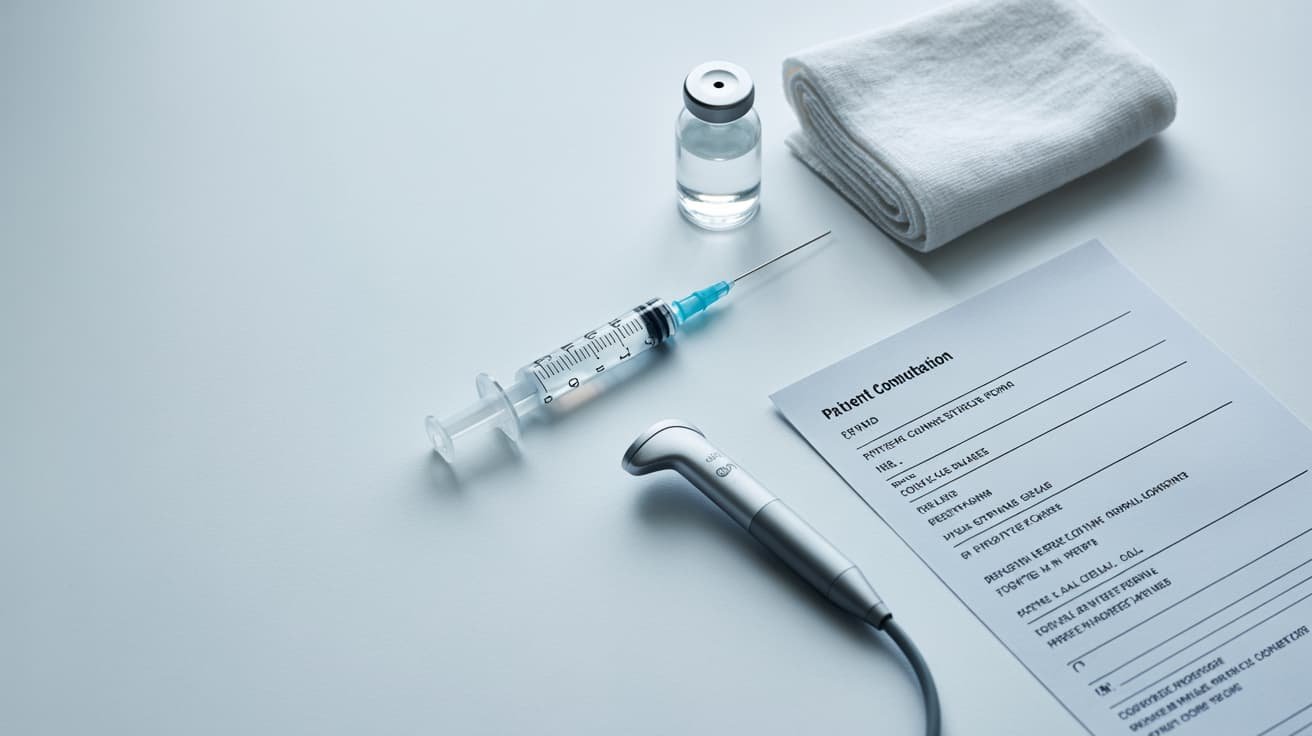
When conservative measures are not giving enough relief, injections are typically the next step.
Steroid Injections (Corticosteroid)
Steroid injections reduce inflammation inside the knee joint. They can provide meaningful short-term relief — often for several weeks to a few months. They are particularly useful for acute flare-ups of osteoarthritis or inflammatory arthritis.
The limitations are important to understand. The relief is temporary. Repeated steroid injections can damage cartilage over time. Most guidelines suggest no more than three to four injections in any single joint. On the NHS, steroid injections for knee osteoarthritis are offered selectively.
Hyaluronic Acid Injections
Hyaluronic acid supplements the natural lubricating fluid in the joint. These injections were once more widely used but NICE no longer recommends them for knee osteoarthritis management — the evidence of meaningful long-term benefit over placebo has not been sufficiently established.
Arthrosamid Injection
Arthrosamid is a newer injectable treatment for mild to moderate knee osteoarthritis. It is a non-biodegradable hydrogel — made of 97.5% water and 2.5% cross-linked polyacrylamide. Unlike steroid injections, it is not a drug and does not work by reducing inflammation temporarily.
When injected under ultrasound guidance, the hydrogel integrates with the synovial tissue — the soft lining inside the joint. This may increase joint elasticity, reduce pain, and improve mobility. Because it is non-biodegradable, it does not break down over time the way other injectables do.
Clinical studies report sustained improvements in pain and function for up to five years after a single injection in suitable patients. A published five-year follow-up study reported continued meaningful improvements at that point. It does not reverse the arthritis, but for the right patient it can significantly reduce pain and restore quality of life without surgery.
Arthrosamid is not currently available on the NHS. It is a private treatment.
Step 4 — Advanced Private Treatments
For patients with more complex presentations or those seeking to avoid or delay surgery, a number of advanced treatments are available privately.
PRP (Platelet-Rich Plasma) injection — uses a concentrated preparation of your own blood platelets to stimulate tissue repair and reduce inflammation. Evidence is growing, particularly for early osteoarthritis.
BMAC (Bone Marrow Aspirate Concentrate) — a more advanced regenerative treatment using stem cells and growth factors drawn from the patient’s own bone marrow.
Shockwave therapy — acoustic waves are applied to the knee to stimulate healing in the surrounding soft tissues. Useful for tendon-related knee pain.
These treatments are generally most suitable for patients who have not responded fully to physiotherapy and injections but are not yet at the stage where surgery is the right option.
Step 5 — Surgery
Knee surgery is appropriate for specific conditions and should not be viewed as the automatic next step after injections fail.
Arthroscopy — keyhole surgery to repair or remove damaged tissue inside the knee, including meniscal tears. Not typically recommended for osteoarthritis alone.
Partial knee replacement (unicompartmental) — replaces only the damaged part of the knee. Suitable for some patients with osteoarthritis limited to one side of the joint.
Total knee replacement — the most significant intervention, replacing the entire joint with a prosthesis. Highly effective for advanced osteoarthritis but carries surgical risk and requires significant rehabilitation. Recovery typically takes three to six months before full function returns.
Surgery is generally considered once conservative options have been exhausted and quality of life is significantly affected. Your surgeon will give you an honest view of whether surgery is the right option for your specific situation.
What Is the Fastest Way to Relieve Knee Pain?
The honest answer is that it depends on what is causing the pain. For acute pain after an injury or a flare-up, rest, ice, and paracetamol will help within 24 to 48 hours.
For ongoing osteoarthritis pain, there is no overnight fix. A steroid injection can reduce inflammation within a few days — but the relief is temporary. Arthrosamid injection produces gradual improvement over eight to twelve weeks as the hydrogel integrates with the joint lining — and the results tend to last significantly longer.
The fastest route to meaningful, sustained relief is the right diagnosis followed by the right treatment for the cause.
What Is the Best Painkiller for Knee Pain?
For mild to moderate knee pain, paracetamol is the first recommendation from NICE. It is effective, safe for most people, and well-tolerated when taken at the recommended dose.
If paracetamol alone is not sufficient, topical diclofenac gel applied to the knee is recommended before progressing to oral anti-inflammatory tablets. Oral ibuprofen or naproxen can help with pain and inflammation but should be used cautiously and not for extended periods, particularly in older adults.
None of these address the underlying structural cause of the pain. They manage the symptom. For longer-term relief, treatment that addresses what is actually happening inside the joint is needed.
Can I Get Knee Pain Treatment on the NHS?
Yes — several treatments are available on the NHS. Physiotherapy, paracetamol and anti-inflammatory prescriptions, steroid injections in some cases, and referral for knee replacement surgery are all part of NHS care pathways.
Waiting times for physiotherapy and specialist referrals vary considerably by area. In some parts of the UK, waits for an orthopaedic consultation are measured in months.
Newer treatments such as Arthrosamid injection, PRP, and BMAC are not currently available on the NHS. If you want access to these treatments, you will need to access them privately.
Arthrosamid Injection Cost UK — What Does It Actually Cost?
Arthrosamid is not a cheap treatment, but it is worth understanding what is included before making a comparison based on price alone.
At Dr SNA Clinic in London, the Arthrosamid injection costs:
| Treatment | Price | What Is Included |
| Single knee | £2,800 | Consultation, ultrasound-guided injection, dual-spin centrifuge protocol, physiotherapy guidance, supplement advice, follow-up support, prophylactic antibiotics |
| Both knees | £5,300 | Everything above for both knees, assessed and treated in one appointment |
| Initial consultation | £100 | Fully redeemable against treatment cost if you proceed |
0% finance is available to spread the cost over several months.
For comparison, steroid injections cost between £150 and £300 each. If you are having three or four a year and the relief keeps diminishing, the cumulative cost — and the cumulative damage to the cartilage from repeated steroids — adds up. Arthrosamid is a single injection with clinical evidence of results lasting up to five years.
When Should I See a Specialist About My Knee?
You should speak to your GP if:
- Knee pain has not improved after several weeks of self-management
- The pain is affecting your sleep, work, or daily activities
- You have significant swelling, warmth, or redness around the knee
- You cannot fully bend or straighten the knee
- The knee gives way or locks during movement
Seek urgent help if:
- You cannot put any weight on the knee
- The knee has changed shape or appears deformed
- You have a very high temperature alongside knee pain and redness — this can indicate infection inside the joint and needs same-day assessment
If you are in London and looking for a private knee specialist, Mr Syed Nadeem Abbas at Dr SNA Clinic (48 Wimpole Street, Marylebone, London W1G 8SF) offers a comprehensive private consultation for £100, redeemable against treatment.

Frequently Asked Questions — Knee Pain Treatment
What causes knee pain in females?
Knee pain in ladies most commonly results from osteoarthritis. Women are disproportionately affected because of hormonal changes at menopause, a wider pelvic Q-angle that increases stress on the knee, differences in quadriceps strength, and greater ligament laxity. Other causes include patellofemoral pain syndrome, meniscal tears, bursitis, IT band syndrome, and rheumatoid arthritis — which affects women three times more than men.
My knee hurts when I bend it and straighten it. Could it be arthritis?
Pain or stiffness on bending and straightening, particularly worse in the morning or after sitting, is a common symptom of knee osteoarthritis. Other signs include creaking, swelling, and pain that worsens with activity. These symptoms alone do not confirm osteoarthritis — a proper clinical assessment with imaging is needed before any diagnosis is made.
Is the Arthrosamid injection available on the NHS?
No. Arthrosamid is not currently available on the NHS. It is a private treatment. NICE has not yet endorsed it as a standard pathway. The Arthrosamid injection cost in the UK varies by provider — at Dr SNA Clinic, it costs £2,800 for a single knee, with 0% finance available.
What is the difference between Arthrosamid and a steroid injection?
A steroid injection reduces inflammation temporarily — typically for a few weeks to a few months. Repeated use can damage cartilage over time. Arthrosamid works differently. It integrates physically with the synovial tissue inside the joint and may provide sustained relief for up to five years from a single injection. The mechanisms are fundamentally different.
Can knee pain be cured?
This depends on the cause. Knee pain from an injury can often be fully resolved. Knee pain from osteoarthritis cannot be cured — the underlying wear cannot be reversed. But it can be managed effectively. Many people with osteoarthritis, with the right combination of physiotherapy, weight management, and appropriate injections, go on to live well without needing surgery.
How long does knee pain last?
Again, it depends on the cause. Mild pain from overuse or a minor injury often settles within two to four weeks. Osteoarthritis is an ongoing condition — it does not resolve on its own. Without treatment, it tends to gradually worsen over time.
What exercises help knee pain?
Low-impact exercises that strengthen the muscles around the knee without putting high impact through the joint are most beneficial. Swimming, cycling, and walking are the foundations. Specific quadriceps-strengthening exercises — such as straight leg raises and wall sits — are commonly recommended by physiotherapists. High-impact activities such as running on hard surfaces should be reduced during a flare-up.
Can I get Arthrosamid if I have both knees affected?
Yes. Both knees can be treated. At Dr SNA Clinic, dual-knee Arthrosamid injection is available for £5,300. Mr Abbas assesses both knees individually before any treatment is agreed.
Summary — Knee Pain Treatment at a Glance
| Stage | Treatment Options |
| Mild / first-line | Rest, ice, paracetamol, topical NSAIDs, gentle exercise, weight management |
| Moderate / ongoing | Physiotherapy, oral anti-inflammatories (short term) |
| Injections | Steroid (short-term relief), Arthrosamid (up to five-year relief, private) |
| Advanced private | PRP, BMAC, shockwave therapy |
| Surgical | Arthroscopy, partial knee replacement, total knee replacement |
Medically reviewed by Mr Syed Nadeem Abbas, MBBS, MRCSEd, MSc (Distinction) — Orthopaedic Consultant and Arthrosamid Specialist, Dr SNA Clinic, 48 Wimpole Street, London W1G 8SF.