
✅Medically reviewed
Over 8.75 million people in the UK have sought treatment for osteoarthritis, according to Versus Arthritis. Many of them eventually find that physiotherapy, painkillers and steroid injections no longer help enough. For this reason, more patients now ask about an Arthrosamid injection for knee pain. This guide uses published trial data to explain the side effects, so you can talk to your clinician with confidence.
What Is an Arthrosamid Injection?
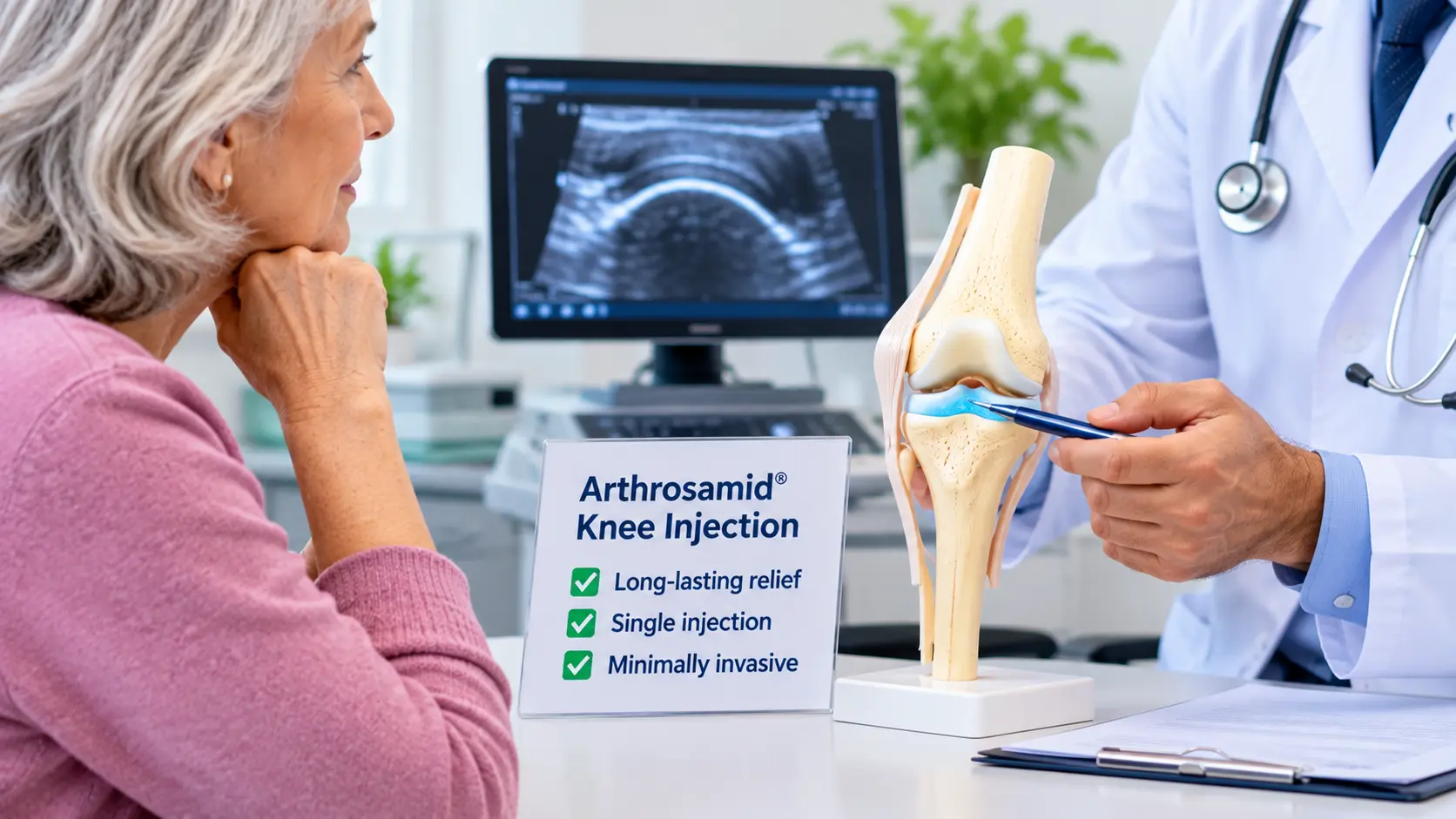
Arthrosamid is a hydrogel made of 2.5% cross-linked polyacrylamide and 97.5% water. First, your clinician uses ultrasound to guide a needle into the knee joint. Then they inject a single 6 ml dose of the gel.
How Arthrosamid Works in the Knee
After the injection, the gel bonds with the synovial membrane, the tissue that lines the joint. As a result, it cushions the joint and can reduce pain. However, it does not repair cartilage.
Unlike steroid or hyaluronic acid injections, Arthrosamid does not break down. In other words, your body never absorbs it. This permanence explains why the effect can last for years. It also explains why Arthrosamid injection side effects deserve careful thought before treatment.
Who Is Arthrosamid For?
Clinicians use Arthrosamid for adults with mild to moderate knee osteoarthritis. Typically, these patients have already tried other treatments without enough relief. You can read more about the procedure on our Arthrosamid treatment page.
Arthrosamid Injection Side Effects: The Full List
Doctors group Arthrosamid injection side effects into three types: common and mild, less common, and rare but serious. The table below gives a quick overview.
| Side effect | How common | Usually lasts | What to do |
|---|---|---|---|
| Increased knee pain (post-injection flare) | Common (15.7% in main trial) | 1–2 weeks | Ice, rest, simple painkillers |
| Joint swelling | Common (10.7% in main trial) | 1–2 weeks | Ice, elevation, avoid high-impact activity |
| Stiffness | Common | First 1–2 weeks | Gentle movement |
| Fluid build-up in the joint (effusion) | Less common | Days to weeks | Usually settles; your clinician may drain it |
| Warmth or redness around the knee | Less common | A few days to a week | Call your clinic if it spreads or worsens |
| Bruising at the injection site | Less common | A few days | No treatment needed |
| Joint infection (septic arthritis) | Rare | Needs urgent treatment | Get urgent medical help |
| Allergic reaction | No pattern in trials; theoretically possible | Varies | Tell your clinician about any allergies |
Common Arthrosamid Injection Side Effects
Increased Knee Pain
This is the most common reaction, and clinicians call it a post-injection flare. It usually settles within one to two weeks. Importantly, a flare does not mean the treatment has failed.
Swelling
Because 6 ml of gel enters the joint, the body reacts with short-lived inflammation. The swelling is usually mild to moderate, and it normally settles without any specific treatment.
Stiffness
Some patients feel stiff in the first week or two. Then, as the inflammation settles, the stiffness eases.
Less Common Side Effects
Joint Effusion
Fluid can build up inside the knee. In most cases, it clears on its own. Occasionally, however, your clinician may need to drain it with a needle (aspiration).
Warmth and Redness
These signs reflect local inflammation. Usually, they fade within a few days to a week.
Bruising
Any needle procedure can cause a bruise at the injection site. Fortunately, it is usually minor.
Rare but Serious Arthrosamid Injection Side Effects
Septic Arthritis (Joint Infection)
Infection is the most serious possible complication of any joint injection. Although it is rare, it is a medical emergency. The knee quickly becomes more painful, swollen and hot, and you may develop a fever. Seek urgent help if this happens, especially after the first flare has settled.
To keep this risk low, the trial teams used ultrasound guidance, strict sterile technique and preventive antibiotics.
Allergic Reactions
The Arthrosamid trials did not show a pattern of allergic reactions to polyacrylamide. Even so, a reaction is theoretically possible, so tell your clinician about any known sensitivities.
Gel Migration
Doctors have raised this concern with polyacrylamide gels in other parts of the body. However, published Arthrosamid knee data has not shown it to be a significant problem.
How Common Are Arthrosamid Injection Side Effects?
The strongest evidence comes from a randomised controlled trial at three sites in Denmark. Researchers gave 239 adults with knee osteoarthritis either one 6 ml Arthrosamid injection or one 6 ml hyaluronic acid injection (Synvisc-One).
Main Trial Results
| Outcome in the main trial | Arthrosamid (n=119) | Hyaluronic acid (n=120) |
|---|---|---|
| Patients with any side effect (related or not) | 45.5% | 41.5% |
| Patients with a device-related side effect | 28.9% | 7.6% |
| Knee pain (arthralgia), device-related | 15.7% | 5.9% |
| Joint swelling, device-related | 10.7% | 2.5% |
| Serious side effects caused by the injection | None | None |
| Injection-related joint infections | None | None |
What the Trial Tells Us
Two findings stand out. First, Arthrosamid caused more short-term pain and swelling than hyaluronic acid. Second, every device-related side effect was mild or moderate.
In addition, the trial recorded nine serious adverse events across both groups, such as pneumonia and heart problems. The investigators concluded that none of them came from either injection.
As for results, Arthrosamid relieved pain at least as well as hyaluronic acid at 26 weeks. Pain scores improved slightly more with Arthrosamid, but the difference was not statistically significant.
Limits of the Evidence
Keep in mind that 239 people is a modest number compared with treatments that have decades of use. Consequently, rare Arthrosamid injection side effects may only appear once many more people have had treatment.
Long-Term Arthrosamid Injection Side Effects: 3- and 5-Year Data
Long-term follow-up now goes well beyond the first trials. Researchers have extended the main randomised trial to three years. In addition, a separate open-label study of 49 patients followed a group of participants for five years.
The authors conclude that these results support Arthrosamid as a long-term treatment for knee osteoarthritis. [Add the specific adverse event figures from these papers once your reviewer has checked the full text.] Still, two limits matter. Only 35 patients entered the five-year extension, and the randomised trial stopped being blinded after the first year.
Why Permanence Matters
Permanence is the biggest difference between Arthrosamid and other knee injections. For example, your body clears a steroid within weeks if it causes a reaction. Arthrosamid, by contrast, stays in the joint. So a complication cannot simply wear off as the substance disappears.
That is not a reason to avoid treatment. Instead, it is a reason to insist on careful patient selection, a trained clinician and an accurate, ultrasound-guided injection.
What If I Need a Knee Replacement Later?
No published evidence suggests that Arthrosamid rules out a future knee replacement. Even so, always tell any future surgeon that you have had it, and ask your clinician about this before treatment.
Who Should Not Have an Arthrosamid Injection?
Not everyone with knee osteoarthritis suits this treatment. Therefore, your clinician should screen you carefully first.
- Active infection in or near the knee: this rules out the procedure, because a permanent gel must never go into an infected joint.
- Inflammatory arthritis, such as rheumatoid or psoriatic arthritis: Arthrosamid targets osteoarthritis, which has a different cause.
- Severe, “bone-on-bone” osteoarthritis: you are less likely to benefit, and a knee replacement often works better.
- Blood-thinning medication: any injection raises bleeding risk, so your doctor needs to review your medication first.
- Pregnancy or breastfeeding: researchers have no safety data for these groups, so treatment should wait.
- Known sensitivity to the gel’s components: discuss this with your clinician before you go ahead.
How to Manage Arthrosamid Injection Side Effects at Home
You can expect some discomfort and swelling for the first one to two weeks. This is normal.
Aftercare Tips
To help your knee recover:
- Apply ice for short periods
- Rest the joint for the first few days
- Avoid running, jumping and other high-impact activity until your clinician says otherwise
- Follow your clinic’s aftercare instructions
When to Contact Your Clinic
Contact your clinic promptly if you notice:
- Pain that gets much worse after the first flare has settled
- Swelling that keeps increasing instead of going down
- Signs of infection, such as fever, chills, a hot joint, or feeling generally unwell
- Any symptom that worries you
Above all, if you have a fever with a hot, very painful, swollen knee, get urgent medical care the same day. When doctors spot a complication early, the outcome is usually much better.
Arthrosamid vs Steroid, Hyaluronic Acid and PRP Injections
In short, Arthrosamid offers longer-lasting relief. In return, you accept a permanent implant and more short-term pain and swelling than with hyaluronic acid.
| Arthrosamid | Steroid injection | Hyaluronic acid | PRP | |
|---|---|---|---|---|
| What it is | Permanent polyacrylamide hydrogel | Anti-inflammatory drug | Lubricating gel that the body absorbs | Concentrate from your own blood |
| Number of injections | Usually one | Repeated as needed | One or a course | Usually a course |
| Typical duration of effect | Studied up to 3–5 years | Weeks to a few months | Months | Months |
| Does the body absorb it? | No | Yes | Yes | Yes |
| Common side effects | Pain and swelling for 1–2 weeks | Flare, temporary rise in blood sugar | Local pain and swelling | Local pain and swelling |
| Available on the NHS? | No | Yes | Not routinely | Not routinely |
Ultimately, the right choice depends on how severe your arthritis is, what you have already tried, and how you feel about a permanent implant. For a side-by-side look, see our PRP injection for knee pain page.
How Much Does an Arthrosamid Injection Cost in the UK?
The NHS does not fund Arthrosamid, so every patient pays privately. Prices also vary widely: published prices for one knee range from about £1,300 outside London to over £3,000 at some London clinics.
Arthrosamid Price at DRSNA Clinic
- One knee: £2,800 (previously £3,200)
- Both knees: £5,300 (previously £6,400)
What the Price Includes
- A full consultation with Mr S N Abbas himself
- A review of your scans before treatment is agreed
- Preventive antibiotics, as the official Arthrosamid guidelines recommend
- An ultrasound-guided injection carried out by Mr Abbas
- Physiotherapy guidance and supplement advice after the injection
- Follow-up appointments at six weeks and twelve weeks
Consultation Fee and Finance
The initial consultation costs £100, and that amount comes off your treatment cost if you go ahead. You can also spread the cost with 0% finance. See our Arthrosamid injection cost page for full details.
Comparing Clinic Prices
When you compare clinics, ask each one for a full price breakdown. In particular, check whether the price covers the consultation, ultrasound guidance, preventive antibiotics and follow-up. A cheaper clinic without ultrasound guidance or a trained clinician is a false economy.
How to Choose a Clinic and Lower Your Risk of Arthrosamid Injection Side Effects
Who performs the injection matters as much as the product itself.
Questions to Ask Before You Book
- Does the clinician use real-time ultrasound guidance? They always should.
- What specialist training does the clinician have in joint injections, and how many Arthrosamid procedures have they done?
- Does the clinic perform the procedure in a sterile clinical room?
- Will the clinician assess how severe your arthritis is before treatment?
- Whom can you contact, day or night, if you develop signs of infection?
Arthrosamid at DR SNA Clinic
Every Arthrosamid Injection at Dr SNA Clinic is performed by Mr Syed Nadeem Abbas personally, from the pre-injection assessment through to the procedure itself. He does not delegate this treatment. Understanding his background helps explain why patients choose to travel to our Wimpole Street clinic from across the UK and internationally.
Frequently Asked Questions
How Long Do Arthrosamid Injection Side Effects Last?
The common side effects (pain, swelling and stiffness) usually settle within one to two weeks. However, if they get worse instead of better, contact your clinic.
Is the Pain After Arthrosamid Normal?
Yes. In fact, a temporary flare of pain is the most common reaction. In the main trial, 15.7% of patients had device-related knee pain, and every case was mild or moderate.
Can a Doctor Remove Arthrosamid?
Arthrosamid is permanent, and your body does not absorb it. As a result, you cannot simply dissolve it if you change your mind, so make the decision carefully.
Can I Walk After an Arthrosamid Injection?
Yes, most people walk out of the clinic. Nevertheless, avoid high-impact activity for the first days to weeks, as your clinician advises.
Is Arthrosamid Safer Than a Steroid Injection?
The two carry different risks. On one hand, your body clears steroids, but they give shorter relief and can raise blood sugar. On the other hand, Arthrosamid lasts longer, but it is permanent and causes more short-term pain and swelling than hyaluronic acid. Both carry a small risk of infection.
Why Isn’t Arthrosamid Available on the NHS?
NICE recorded it as “not selected” for guidance because it judged the evidence insufficient. Meanwhile, private clinics in the UK can still offer it.
Summary: Arthrosamid Injection Side Effects
Overall, Arthrosamid injection side effects are mostly mild, temporary and manageable for carefully selected patients. Pain and swelling in the first two weeks are common and expected. Serious complications are rare but real, so learn the warning signs.
Above all, permanence sets Arthrosamid apart. That is not a reason to avoid it or to rush into it. Instead, it is a reason to get fully informed, choose an experienced clinician who uses ultrasound guidance, and discuss your options openly.
Book a consultation to find out whether Arthrosamid suits your knee.
Read More:
Is Arthrosamid Injection the Right Knee Pain Treatment for You?
Arthrosamid Injection vs Steroid and Hyaluronic Acid Injections for Knee Pain