

Knee pain is one of the most common complaints we see at Dr SNA Clinic. Whether you’re dealing with the early signs of osteoarthritis, recovering from an injury, or just feeling that familiar ache after a long day on your feet — you’re far from alone. Millions of people across the UK live with chronic knee pain, and for many, the first line of support isn’t a pill or a procedure. It’s movement.
Regular, targeted exercise can strengthen the muscles that support your knee, reduce stiffness, improve your range of motion, and ease pain over time. The key is choosing the right exercises — ones that are gentle enough not to cause harm, but effective enough to make a real difference.
Below, we’ve put together 10 exercises specifically recommended for knee joint pain. Start slowly, listen to your body, and build up gradually. If you’re unsure whether any of these are suitable for your specific condition, please speak to your doctor or physiotherapist first.
1. Straight-Leg Raise (Seated)
This is one of the simplest exercises you can do, and it’s a great starting point if your knee is very sore.
How to do it: Sit upright in a sturdy chair with your back straight. Slowly straighten and raise one leg until it’s parallel to the floor. Hold for a count of five, then lower it gently. Do 10 repetitions on each side.
Why it helps: It strengthens your quadriceps — the large muscle group at the front of your thigh — without putting any load on the knee joint itself.
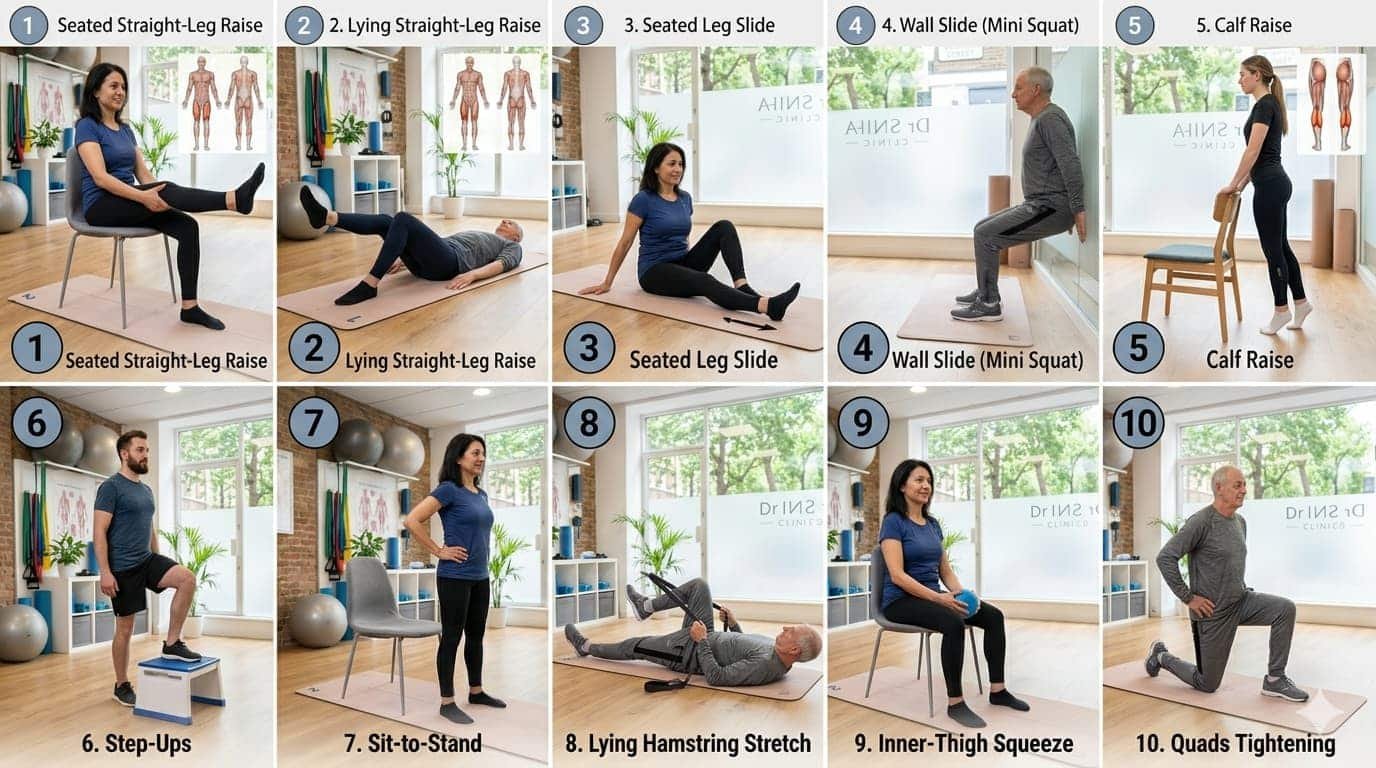
2. Straight-Leg Raise (Lying Down)
A variation of the above, this version is ideal first thing in the morning or last thing at night.
How to do it: Lie on your back on a firm surface. Bend one knee so your foot is flat on the floor. Keep your other leg straight, then lift it to the height of the bent knee. Hold for five seconds, then lower slowly. Repeat five times on each leg.
Why it helps: This activates the quads and hip flexors without any knee flexion, making it safe for people with significant pain or swelling.
3. Leg Slide (Seated)
How to do it: Sit on the floor or a firm surface with both legs stretched out in front of you. Slowly slide one foot back towards your body, bending the knee until you feel a gentle stretch. Hold for five seconds, then slide it back out. Repeat 10 times on each side.
Why it helps: This gradually improves your knee’s range of motion — something that’s particularly important if stiffness is making daily activities like climbing stairs or getting up from a chair more difficult.
4. Wall Slide (Mini Squat)
How to do it: Stand with your back flat against a wall, feet shoulder-width apart and positioned slightly in front of you. Slowly slide down the wall, bending your knees to about a 30-degree angle. Hold for five seconds, then slide back up. Repeat 10 times.
Why it helps: Wall slides activate the quads, hamstrings, and glutes without straining the knees. They’re a brilliant stepping stone towards full squats once your strength improves.
5. Calf Raises
How to do it: Stand behind a chair and hold the back for balance. Rise up on your tiptoes slowly, hold for two seconds, then lower back down. Aim for 15–20 repetitions.
Why it helps: Strong calf muscles improve the overall stability of the knee joint and encourage healthy circulation in the lower leg — which matters a great deal when inflammation is present.
6. Step-Ups
How to do it: Use the bottom step of a staircase. Step up with your right foot, then bring up your left. Step down with your right, then the left. Repeat until you feel fatigued, rest for a minute, then do two more sets. Hold the bannister for support if needed.
Why it helps: Step-ups mimic everyday movements and build real functional strength around the knee. As you progress, you can use a slightly higher step.
7. Sit-to-Stand
How to do it: Sit towards the front of a sturdy chair. Without using your hands, slowly stand up, then sit back down in a controlled manner. Aim for 10–15 repetitions per set, three sets in total.
Why it helps: This is one of the most functional exercises you can do. It directly trains the muscles you use to get up from a chair, off a toilet seat, or out of a car — movements that become challenging with knee pain.
8. Hamstring Stretch (Lying)
How to do it: Lie on your back and bend both knees. Lift one leg and hold the back of your thigh with both hands. Gently straighten the knee as much as you comfortably can. Hold for 20–30 seconds. Repeat twice on each side.
Why it helps: Stretching tight hamstrings reduces tension and helps maintain better knee alignment. Tight hamstrings pull on the knee joint and can worsen pain over time.
9. Inner-Thigh Squeeze (Adductor Activation)
How to do it: Sit in a chair with your knees bent at 90 degrees. Place a rolled-up towel, small pillow, or soft ball between your knees. Gently squeeze your knees together, hold for five seconds, then release. Do 15 repetitions.
Why it helps: The adductor muscles on your inner thigh play an important role in stabilising the knee. Strengthening them can reduce the load on the knee joint, particularly on the inner side where osteoarthritis commonly develops.
10. Quads Tightening (Static Quad Set)
How to do it: Sit or lie on the floor with your legs stretched out flat. Tighten the muscles on the top of one thigh by pressing the back of your knee gently down into the floor. Hold for five seconds, release, and repeat 10 times on each leg.
Why it helps: This is possibly the gentlest exercise on the list — and perfect for days when pain levels are higher. It maintains muscle engagement without any movement of the knee joint at all.
A Few Tips Before You Get Started
- Warm up first. A five-minute walk or gentle cycling on a stationary bike will loosen up your joints before you exercise.
- Don’t push through sharp pain. Mild discomfort is normal; sharp or worsening pain is a signal to stop.
- Consistency matters more than intensity. Short daily sessions beat occasional marathon efforts every time.
- Ice after exercise if you experience any swelling or warmth in the knee.
When Exercise Alone Isn’t Enough
Exercise is a cornerstone of knee pain management, and we’d always encourage it as a first step. But for some people — particularly those living with moderate to severe knee osteoarthritis — exercise alone may not provide lasting relief.
This is where treatments like Arthrosamid Injection come in.
Arthrosamid is a cutting-edge, single-injection treatment for knee osteoarthritis. It’s a polyacrylamide hydrogel that integrates into the soft tissue lining of the knee joint (the synovium), helping to cushion and protect the joint from within. Unlike traditional steroid injections or hyaluronic acid, Arthrosamid is designed to provide long-lasting relief — potentially for several years — from a single treatment session.
At Dr SNA Clinic, we offer Arthrosamid Injection as part of a comprehensive approach to knee pain management. Dr Syed Nadeem Abbas will assess your knee thoroughly and discuss whether this treatment is appropriate for your situation. Many of our patients find that combining Arthrosamid with targeted exercises delivers the best overall outcome — the injection reduces pain enough to allow more consistent exercise, and exercise helps maintain the health of the joint over time.
Ready to Take the Next Step?
If your knee pain is affecting your quality of life, don’t wait for it to become unmanageable. Come and speak to us. We’ll listen, assess, and recommend the right course of action — whether that’s a structured exercise plan, an Arthrosamid Injection, or a combination of treatments tailored specifically to you.
Contact Dr SNA Clinic
Dr SNA Clinic
48 Wimpole Street, Marylebone, London W1G 8SF
📞 Phone: +44 7955 836986 | +44 20 3846 7111
📧 Email: info@drsnaclinic.com
🕐 Hours: Monday–Friday: 9:00 AM–6:00 PM | Saturday: 10:00 AM–4:00 PM | Sunday: Closed
Book a Consultation: https://drsnaclinic.com/booking
What Is Polyacrylamide Hydrogel and Why Is It Used in Arthrosamid?